Automatic Gate Repair Plano › Sliding Gate Repair
Plano sliding gate repair
Sliding Gate Repair Plano
Rolling and cantilever gates fail through the chain, the track, and the rollers — long before the operator is the problem. We fix the drive train, not just the symptom.
- Free estimates
- Licensed and insured
- Same-day service
Plano · West Plano · Frisco · Allen · Murphy · Richardson
Get A Free Quote
Tell us where the gate stops and what it sounds like. The estimate is free.
Drive train
A slide gate wears out along its whole length.
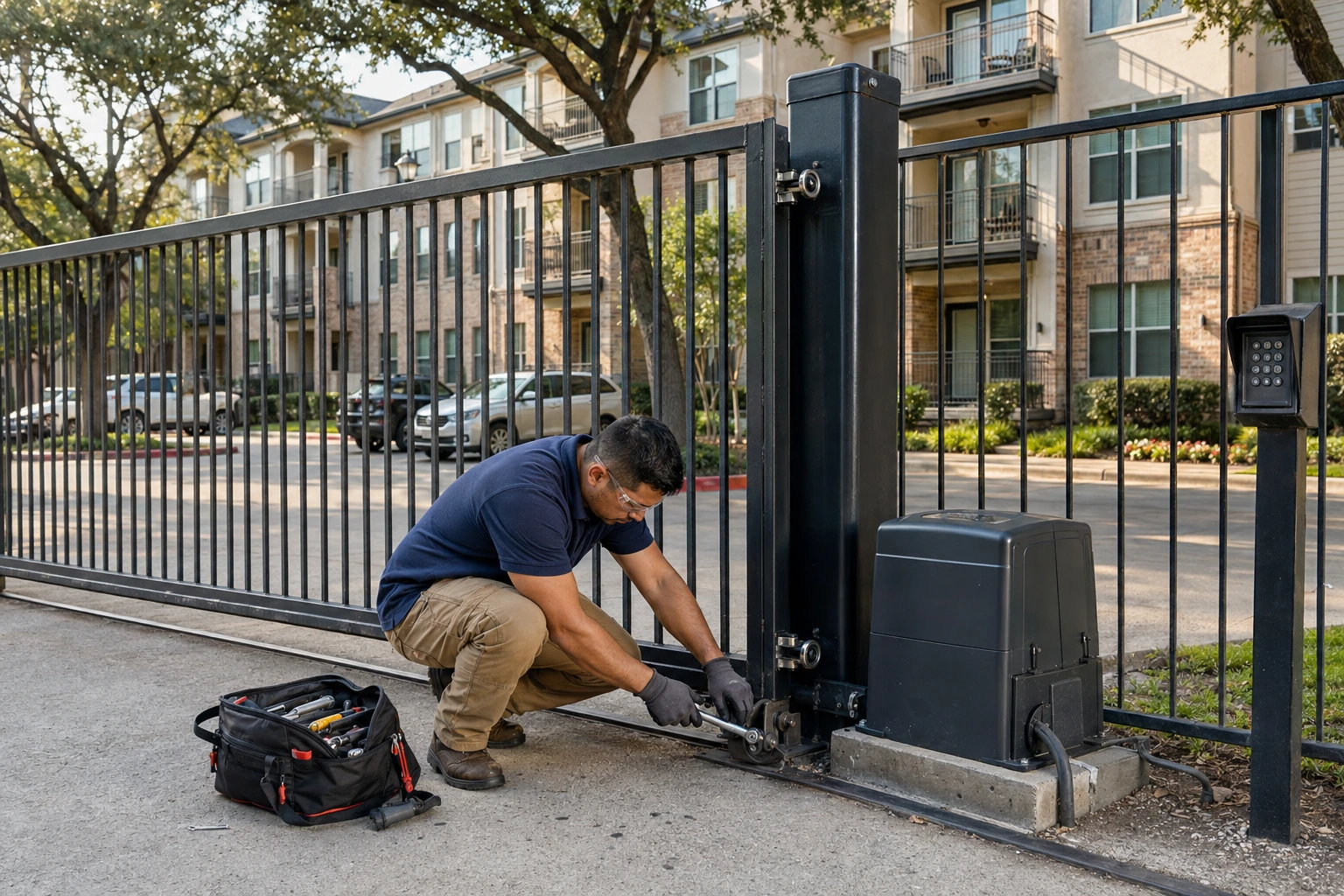
Sliding gates carry their weight sideways across rollers and pull themselves along a chain. That means the failure points are spread across the run of the gate rather than concentrated at one hinge. A gate that grinds on the track, sticks at the same spot, or has stopped halfway is describing a drive-train problem. Sliding gate repair in Plano is mostly wear-part work on that drive train.
- 01
Gate off track
A sliding gate off track has jumped its V-track. Usually debris in the track, a worn guide roller, or a wheel that finally gave up. Do not force it back on — a derailed gate is heavy, unbalanced, and the most likely thing on a property to hurt someone.
- 02
Broken or slack chain
Most slide operators drive the gate with a chain. Chains stretch, links break, and the gate stops dead mid-travel. Retensioning is routine. A chain broken outright means the gate is free to roll, which is a security problem before it is a repair problem — and a chain left dragging picks up grit that grinds into the metal and accelerates everything downstream.
- 03
Worn sprocket teeth
A sprocket that has hooked its teeth into a shark-fin profile skips under load. You hear it as a rhythmic clunk at the same point in every cycle, and it will eat a new chain if the chain alone gets replaced.
- 04
Rollers and wheels
V-groove wheels flatten, seize, and rust. A gate that has gotten noticeably harder to move by hand is telling you the operator is now working against the rollers rather than moving the gate. Roller replacement is routine wear work, not a rebuild.
- 05
Track debris and grade issues
Ground track collects gravel, mulch, and North Texas clay that heaves after wet weather. A sliding gate grinding on the track or binding at the same spot every time is almost always a track problem, not an operator problem.
- 06
Cantilever roller assemblies
Cantilever gates carry their weight on roller trucks bolted to the posts rather than a ground track. When those wear, the gate sags at the leading edge and starts dragging. If the bracket or its post mount has flexed, a new roller alone will not stop the gate wandering — the mount gets checked with the roller.
Two designs
Rolling or cantilever — they are not the same repair
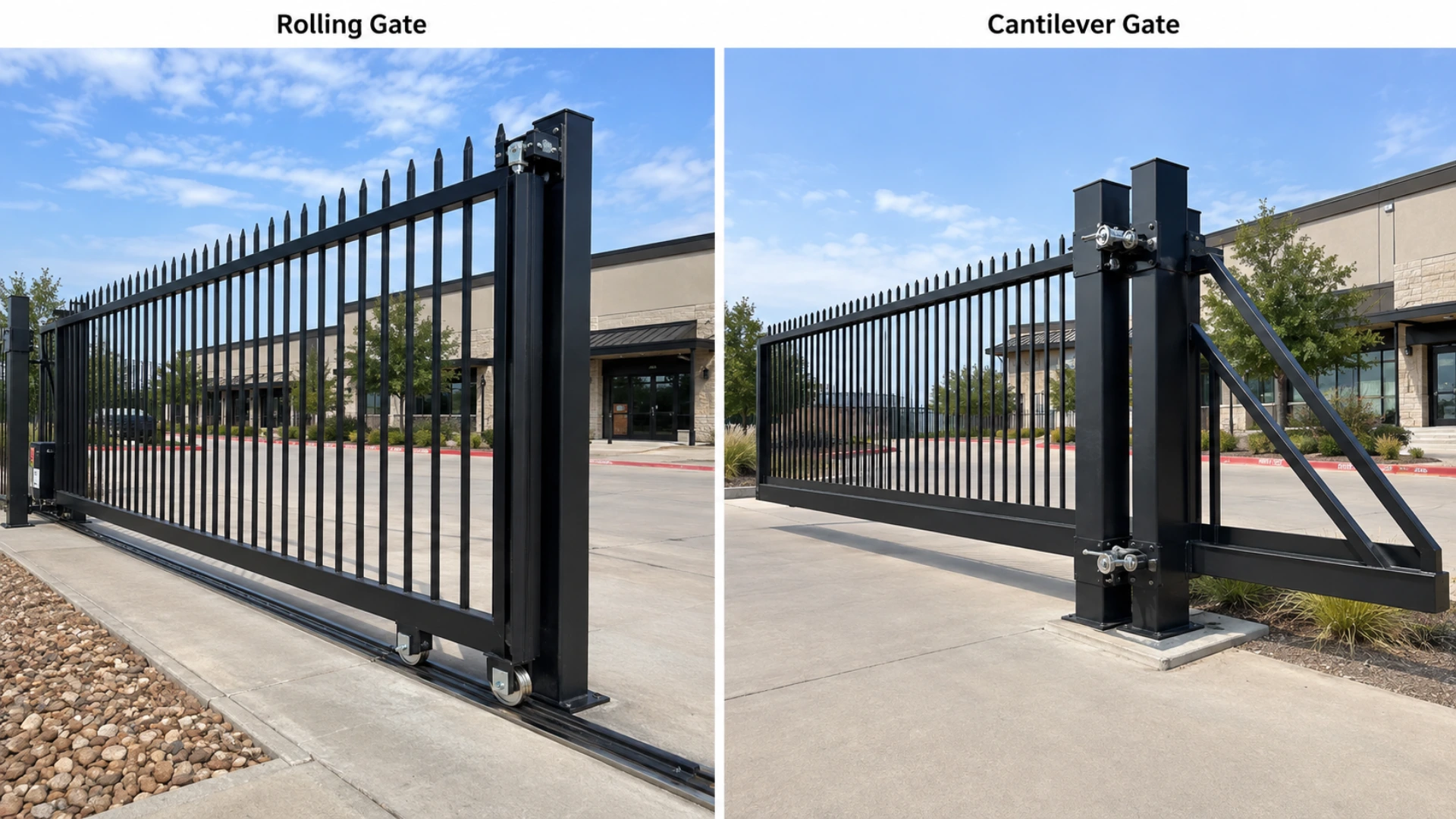
Two gates that look alike from the driveway carry their weight in completely different ways, and almost nothing written locally tells you which one you have.
- Rolling gates ride on wheels that sit in a track set into the driveway. The track is the thing that fails — debris, cracked footing, a section that has heaved. Roller profiles differ too, V-groove, round groove and U-track among them, and the wrong replacement will not seat correctly.
- Cantilever gates have no ground track at all. They hang from roller trucks mounted on posts beside the opening and counterbalance across a tail section. Nothing crosses the driveway, which is why they get specified where the ground moves.
- How to tell in ten seconds: look at the ground across the opening. A rail or channel means rolling. Bare driveway with the hardware up on the posts means cantilever.
- Why it changes the visit: different parts on the truck. Saying which you have when you call is the difference between one trip and two.
Not sure which you have? Describe the opening on the phone and we will tell you. Call {phone}.
Symptoms
Where the gate stops tells you what failed
This is the single most useful thing you can notice before calling, and it costs you nothing. Watch the gate through one cycle and note where it gives up.
- It stops at the same place every time
- Consistency points at something physical. A high spot in the track, a bad section of rail, a roller that seizes at one point in its rotation, or a gate that is dragging where the grade rises. The operator is reading the extra load as an obstruction and doing exactly what it should.
- It stops in a different place each time
- That is usually electrical rather than mechanical — a limit magnet that has shifted on its bracket, a failing limit sensor, or a safety input reading a false signal. Sliding gate motor problems and gate problems present identically to the person standing in the driveway.
Gate opening slowly, or grinding on the way through? That is worth a call before it becomes a gate that will not move at all. Ring{phone} and say where it stops.
Alignment
Most slide-gate repairs fail because the line is crooked
Rollers, chain and sprockets are wear parts and they are supposed to be replaced. But they wear at the rate the drive line dictates, and a line a few degrees out of true wears rollers dramatically faster than a straight one. Fit a new chain to a crooked line and you buy the same failure again in a fraction of the time.
- The track is not level any more
- Collin County clay swells and shrinks through the year and it moves what is buried in it. A cracked footing or a settled section of track puts the gate out of level along its run, and every roller and every chain link downstream of that is now loaded wrong.
- The operator is sitting at an angle
- A slide operator is supposed to pull the chain straight down its line. When the pad has shifted or the mount has loosened, the chain pulls off-axis. That shows up as uneven chain stretch, a new noise, and sprocket wear on the sides of the teeth rather than the working faces — wear that points at the mount, not the part.
Stuck open
If your sliding gate is stuck open, call before anything else
A sliding gate stuck open leaves the property unsecured, and a derailed one is a genuine hazard sitting in a driveway. Those calls get routed first. Tell us it is off the track when you call so the truck arrives with the right rollers.
- Don't push a derailed gate back onto the track by hand. It is heavier than it looks and it is no longer balanced.
- Don't run the operator again once you've heard grinding — that's how a chain problem becomes a sprocket and motor problem.
- Do clear obvious debris out of the ground track if it is safe to reach.
- Do note whether the gate is hard to move by hand with the operator released. That one observation separates a gate problem from an operator problem before anyone arrives.
Repair first
Repair first on slide gates, specifically
Rollers, chain and sprockets are consumable. Replacing them is not the same conversation as replacing a gate. The estimate is free and you'll hear the repair number before you hear anything else.
If the drive train checks out and the fault is in the unit itself, that is gate operator repair Plano. Have a swing gate instead? The failure set is completely different — seeswing gate repair Plano. Running a slide gate at an apartment or storage property? Seecommercial gate repair Plano. Still choosing between the two types for a new opening? Seeswing vs sliding gate cost. Or start at automatic gate repair Plano.
Same-day service
Gate down today?
We're usually out the same day. The estimate is free, and you'll know what it needs and what it costs before we start.
Call {phone}