
Automatic Gate Repair Plano › Swing Gate Repair
Plano swing gate repair
Swing Gate Repair Plano
Swing gates fail at the hinge, the post, and the arm. Fix the geometry and the operator usually stops complaining on its own.
- Free estimates
- Licensed and insured
- Same-day service
Plano · West Plano · Frisco · Allen · Murphy · Richardson
Get A Free Quote
Tell us how the gate sits and where it binds. The estimate is free.
Where it fails
A swing gate's problems concentrate at one corner.
Everything a swing gate does depends on a leaf staying square and a post staying vertical. When either drifts, the gate drags, the operator works harder than it was designed to, and the failure eventually moves from the hinge into the arm and then into the motor. That is why swing gate repair in Plano starts with the geometry and only then looks at the electronics.

- 01
Sagging gate leaf
The defining swing-gate failure. The far edge of the gate drops, the gate starts dragging or catching on the latch post, and the operator strains through every cycle. Sag is usually the hinge or the post, not the gate itself.
- 02
Worn or seized hinges
Swing gates put their entire weight on two or three hinges that pivot thousands of times a year. When a hinge wears oval or a bearing seizes, the gate binds, squeals, and pulls the post out of plumb behind it.
- 03
Leaning or heaving post
North Texas clay moves. A hinge post that has tilted even slightly throws the whole arc of the gate off, and no amount of operator adjustment fixes a post that is no longer vertical. This is the repair most often skipped and most often the actual cause.
- 04
Linear actuator arms
Ram-style operators fail at the arm — a bent shaft, a worn bushing, a leaking hydraulic ram, or a nut that has backed off its mount. The gate moves erratically or stops partway through its arc.
- 05
Articulated arm operators
Jointed arms used where the operator sits behind the post. Their pivot points wear and their mounting brackets loosen, which shows up as a gate that jerks at the start of travel or shudders as it opens.
- 06
Gate opens then reverses
On a swing gate this is often mechanical rather than electronic. A binding hinge or a dragging leaf raises the load, the operator reads that as an obstruction, and it reverses exactly the way it is designed to. Fixing the drag fixes the reversing.
Diagnosis order
Diagnosing a sagging gate in the right order
Swing gate sagging is the complaint we hear most, and it gets misdiagnosed constantly because the symptom shows up furthest from the cause. The gate drags at the latch side; the problem is usually at the hinge side or in the ground. There is a fixed order to checking it.
- Check the post first, not the hinge
- The order matters, because a post that has gone out of plumb makes perfectly good hinges look worn. A post leaning even a fraction of an inch away from the opening throws the gate's whole arc off, and Blackland Prairie clay under Plano moves post footings year-round as it swells and shrinks with the rain.
- Then check whether the gate is still square
- A gate frame that has racked is twisting under its own weight and is no longer a rectangle. On a gate whose frame has gone out of square, no hinge adjustment holds — the geometry has to be brought back before the hardware means anything.
- Hardware last
- Loose fasteners, holes that have wallowed out oversize, crushed material under a hinge plate. Real failures, and the cheapest of the three to fix — which is exactly why they get blamed for sag that is actually coming from the post.
Gate dragging on the ground, or catching on the latch post? Hinge repair and post repair are both routine. Call {phone}.
Arm operators
Arm operators, and why the mount matters
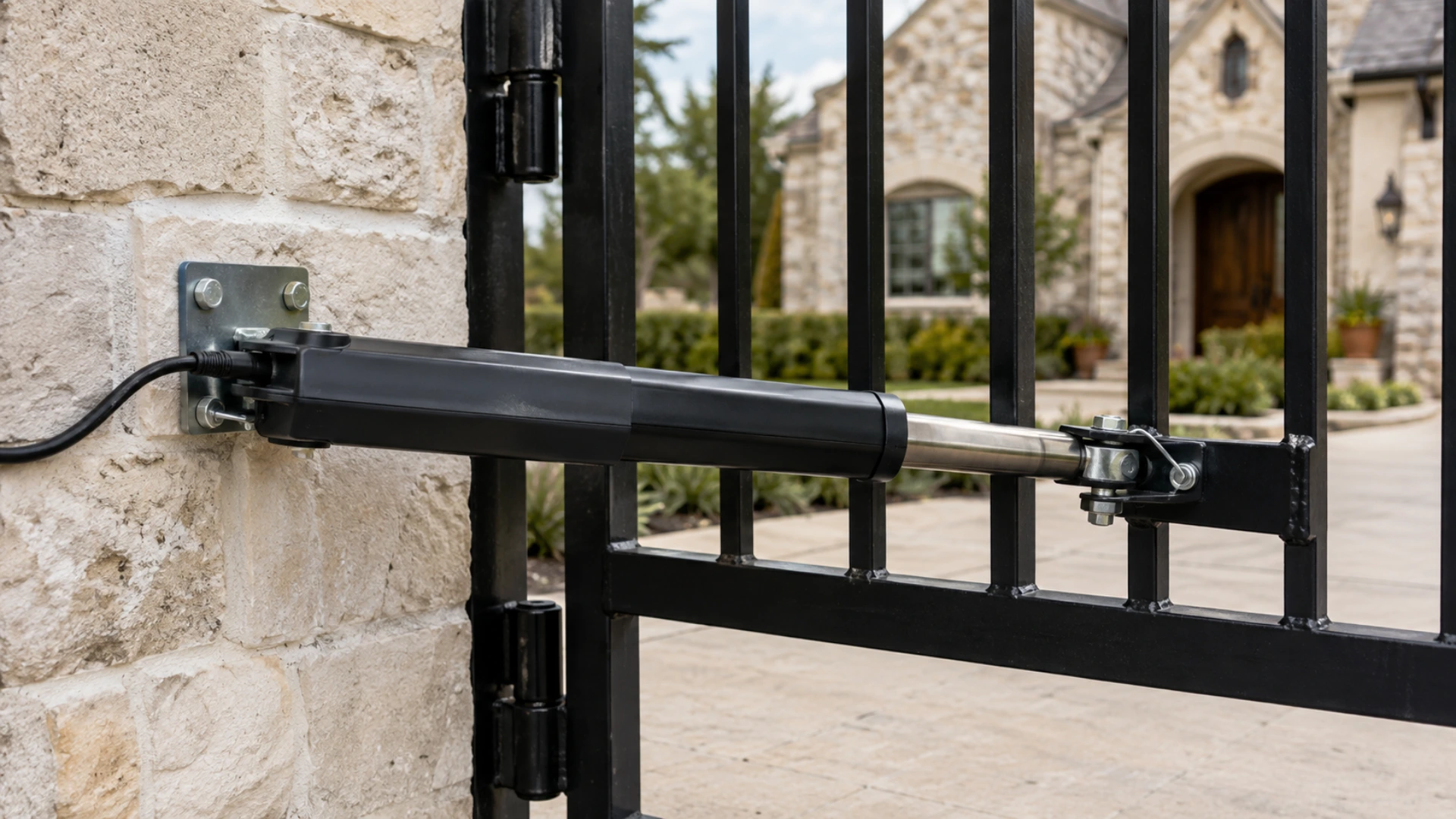
A swing gate is moved by an arm, and which arm you have was decided by the width of your post and how much room there is behind the gate. They wear differently and they mount differently. Both transfer the whole load of the gate through two brackets, so an arm replaced without correcting its mounting geometry is a new arm with the old problem.
- Linear actuator arms
- A ram that pushes straight from a bracket on the post to a bracket on the gate. The common choice where the post is narrow. They fail at the arm — a bent shaft, a worn bushing, a leaking ram, or a mounting nut that has backed off — and the gate moves erratically or stops partway through its arc.
- Articulated arm operators
- A jointed arm used where the pillar is wide or the setback is tight, because it can reach around a column a straight ram cannot clear. Their pivot points wear and their brackets loosen, which shows up as a gate that jerks at the start of travel or shudders as it opens.
Gate arm not moving at all, on one side or both? Say which side when you call {phone} — it narrows the fault before the truck leaves.
Double gates
Double swing gates fail in their own particular ways
Two leaves means two operators that have to agree with each other, and a set of failures a single gate simply cannot have. Leaves that meet unevenly are the third: usually one has sagged relative to the other, and it gets diagnosed the same way — post, frame, then hardware.
- One leaf moves and the other doesn't
- On a double gate the two operators are set up as a pair, one leading and one following. When one leaf sits still, it is usually that operator, its arm, or its wiring — not the pair. The working half proves the board and the inputs are alive.
- They close out of order and won't latch
- Double gates that overlap have to arrive in sequence, and the controller holds one leaf back by a few seconds so they do. When that delay drifts or gets lost, the leaves meet wrong and a lock or overlap cannot engage. That is a setting, not a broken gate.
Geometry first
Why a new operator often doesn't fix a swing gate
This is the most common bad outcome we get called in behind. A gate sags, the operator struggles, someone replaces the operator, and the new one struggles too — because the load never changed. Repair-first on a swing gate usually means repairing the hinge and the post, which is cheaper than the operator that was about to be replaced.
If the arm and the geometry check out, the fault is in the operator itself: gate operator repair Plano. Have a rolling gate instead? The failure set is completely different — seesliding gate repair Plano. Swing gates at a community entrance are the same mechanics with a board attached: HOA gate repair Plano. Or start at automatic gate repair Plano.
Scope
Gate opening but not closing?
On swing gates that pattern splits two ways: a safety device that has faulted, or a mechanical bind on the closing arc that the operator is correctly reading as an obstruction. Both are diagnosable on the first visit.
If your swing gate won't close, tell us whether it stops in the same place every time. A consistent stopping point points at the bind; an inconsistent one points at a sensor. Call {phone}.
Deciding between a swing gate and a slide gate for a new opening? The trade-offs and the published cost ranges are laid out inswing vs sliding gate cost.
Same-day service
Gate down today?
We're usually out the same day. The estimate is free, and you'll know what it needs and what it costs before we start.
Call {phone}