Automatic Gate Repair Plano › Gate Operator Repair
Plano gate operator repair
Gate Operator Repair Plano
The operator is the machine that moves the gate — and it is where most gate failures actually live. We diagnose the unit itself, down to the board, before anyone talks about replacing it.
- Free estimates
- Licensed and insured
- Board-level diagnosis
Plano · West Plano · Frisco · Allen · Murphy · Richardson
Get A Free Quote
Tell us what the operator is doing. The estimate is free.
Operator failures
"The motor is dead" is usually wrong.
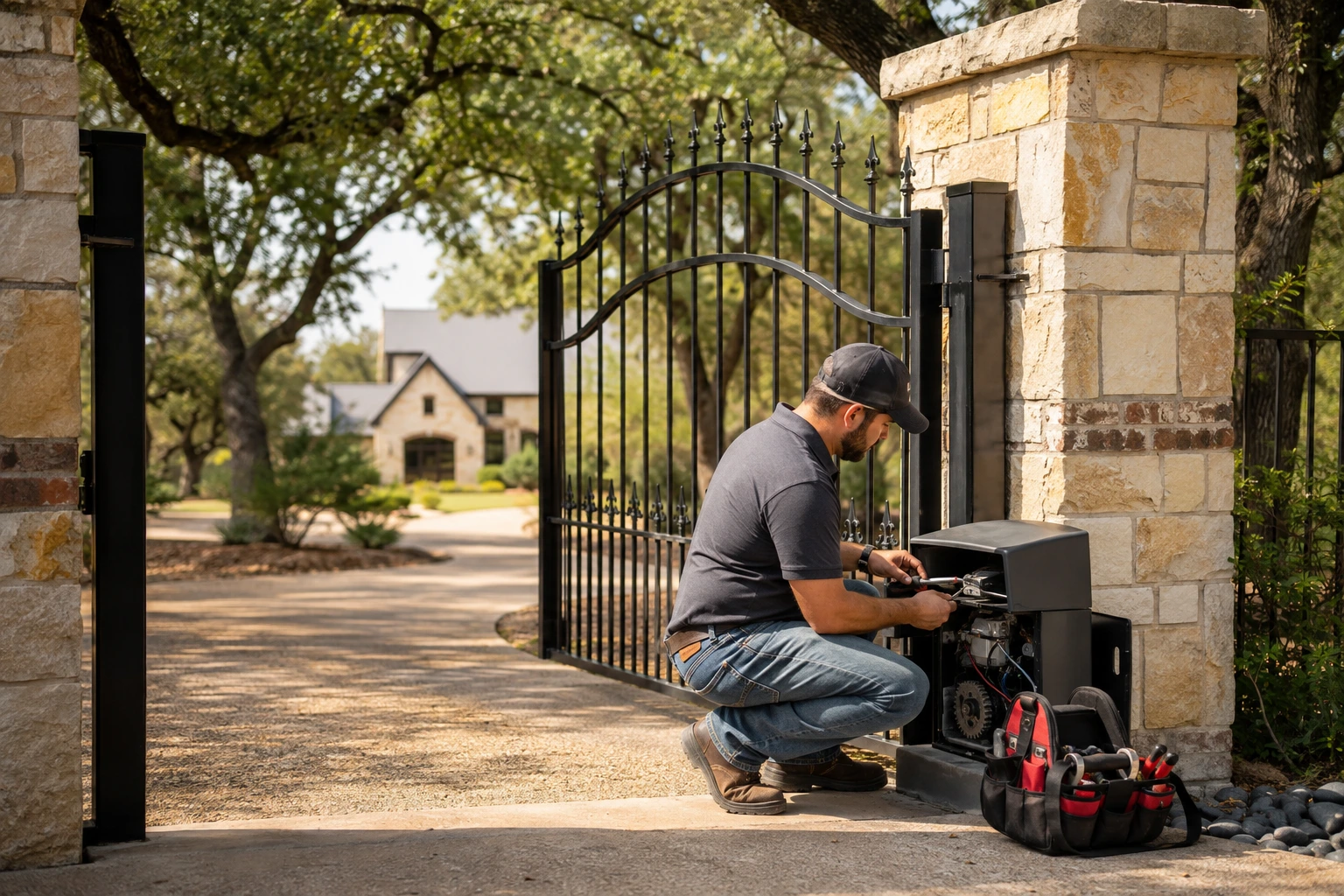
When a gate stops moving, the operator gets blamed as a single unit. It is not one thing. It is a motor, a gearbox, a control board, limit switches, a capacitor, a transformer, and a battery — each of which fails on its own and each of which is replaceable on its own. Gate motor repair and gate opener repair in Plano nearly always mean replacing one of those parts, not the operator.
- 01
Control board
The most common operator failure we see in North Texas, and the one most often misdiagnosed as a dead motor. Heat, surges, and storm outages take boards out. The gate goes completely unresponsive, or it responds to one input and ignores the rest. A board is a part, not a new operator.
- 02
Limit switches
Limits tell the operator where open and closed actually are. When they drift, the gate stops short, runs past its stop, or slams. On a mechanical limit that is a worn cam or a loose set screw; on a magnetic limit it is usually a shifted magnet or a failed reed.
- 03
Capacitor
A gate motor humming or clicking but not moving is describing a capacitor almost every time. The motor is trying to start and cannot. It is an inexpensive part that gets a lot of operators condemned unnecessarily.
- 04
Gearbox and drive train
Grinding, chattering, or a gate that runs slower than it used to. On a gearbox that has lost oil or stripped, the repair decision is real — but it is still a decision, and you get the numbers for both paths before anything happens.
- 05
Transformer and power supply
No lights on the board at all usually means the operator never got power. Blown transformer, tripped breaker, damaged low-voltage run, or a solar setup whose battery is finished.
- 06
The motor itself
Genuinely dead motors are the minority of what we find, but they exist. The tell is heat and current draw rather than silence — a gate that runs for a while, then stops with a hot operator, or one that keeps tripping its breaker, is drawing more power than it should. That is a motor or a mechanical load pulling on it, and the two get separated before anything is quoted.
- 07
Battery backup
Most operators hold a battery so the gate keeps working through an outage. Those batteries die quietly. Owners find out during the outage, which is the worst possible time.
Diagnosis
How we diagnose an operator
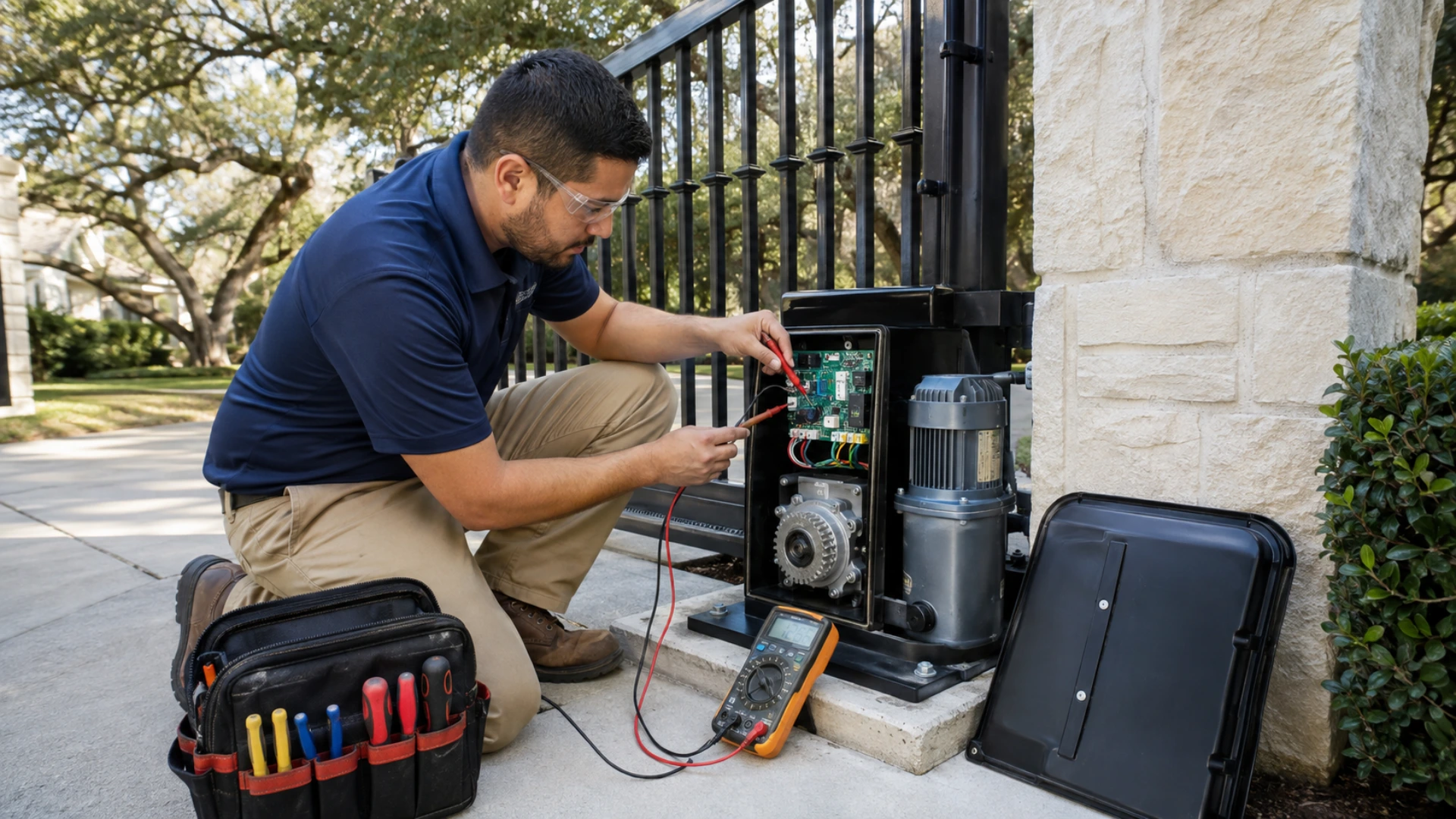
- Confirm the operator is getting power, and that the board is getting power — those are two different questions.
- Read the board's diagnostic indicators before touching anything mechanical. Most boards report their own faults through an LED or a code, and that reading narrows the problem before a single part comes off.
- Separate the health of the operator from the condition of the gate. A perfectly good motor fighting a dragging gate, a worn roller, or a misaligned rack presents exactly like a failing motor, and gate motor repair that ignores the load is a repair you pay for twice.
- Separate an input problem from an operator problem: a gate that ignores the remote but runs from the board's own button is a receiver or transmitter issue, not a motor issue.
- Check the safety inputs. Operators are designed to refuse to move when a photo eye or loop is faulted, and a refusing operator looks identical to a broken one.
- Run the gate through a full cycle and check limits, reversing force, and travel speed.
- Give you the repair number first, and the replacement number only if the repair does not make sense — with the reason for it.
Gate not working after a power outage is usually a control board that lost its programming or a surge that took the board out — a repair, not a replacement. A gate that won't open at all, with no lights on the board, is a power question before it is a motor question. Either way, say which one you're seeing when you call{phone}.
Gate died when the power came back after a storm? Work throughgate opener not working after power outagebefore you call — a few of those checks you can do yourself.
Operator types
Which kind of operator you have changes the repair
“Gate operator” covers two fairly different machines, and almost nothing written locally distinguishes them. They fail in different ways and carry different spares, so a diagnosis that does not say which one you have is not really a diagnosis.
- Electromechanical operators
- The common type on residential and light commercial gates. A motor turns a gearbox, which turns a chain, a rack, or an arm. They wear rather than fail suddenly, and they are the friendlier of the two to repair on site — gear sets, limit switches, and belts are replaceable parts rather than a sealed unit.
- Hydraulic operators
- Found where a gate is heavy, long, or running a serious number of cycles a day. An electric motor pressurizes fluid, and valves push the gate. They break down less often and cost more when they do, and their failures read differently — a slow or weak gate is often a pressure or valve problem, and a leak at the ram is a hydraulic symptom with no electromechanical equivalent.
Early warnings
An operator tells you it is failing before it fails
Almost every dead-gate call we take had a warning period that somebody lived with. The gate did something slightly wrong for weeks, everyone adapted, and then it stopped entirely on the worst possible morning. Caught during the warning period, most of these are small repairs.
- It works, then it doesn't
- The single most ignored warning sign. A gate that needs the remote pressed three times, or runs fine on Tuesday and not Thursday, is not being temperamental. Intermittent operation usually comes before total failure, and it is the cheapest moment to fix the thing.
- A new noise
- Grinding, chattering, and clicking are each pointing somewhere specific. Clicking without movement is usually the start circuit. Grinding under load is usually the gearbox or the drive train. A new sound is diagnostic information, not background noise.
- The operator is hot to the touch
- An operator running hot is working harder than it was rated for, which is either a mechanical problem in the gate or an operator undersized for the job. Replacing a motor without answering which one it is buys you the same failure again.
Gate opening slowly, humming, or grinding? That is worth a call before it becomes a gate that will not open at all. Ring {phone}and describe the sound.
Scope
Operator problems by gate type
The operator is the part every gate shares, but how it fails depends on what it is pushing. A slide operator fights a chain and a track; a swing operator fights an arm, a hinge, and a post.
Not sure what you have? Call {phone} and describe what the gate is doing. Or start atautomatic gate repair Plano.
Same-day service
Gate down today?
We're usually out the same day. The estimate is free, and you'll know what it needs and what it costs before we start.
Call {phone}